> For the complete documentation index, see [llms.txt](https://docs.dinmo.io/llms.txt). Markdown versions of documentation pages are available by appending `.md` to page URLs; this page is available as [Markdown](https://docs.dinmo.io/models/computed-fields/related-fields.md).
# Related Fields
Map a field from a related model in an activation without adding it to the parent model.
Related fields make a field from a singular related model available for an activation, without adding unnecessary columns to the parent model.
For example, you may activate Transactions and need to map a product attribute such as `product_type`. Instead of enriching the Transactions model with product columns, create a Related field that references `product_type` from the Products model.
The field is then available in the activation mapping.
## When to use a related field
Use a Related field when:
* The field you need for an activation belongs to a related model.
* The parent model is linked to the related model through a `1:1` or `N:1` relationship: each record in the parent model is associated with at most one record in the related model.
* You want to keep the parent model focused on its own data.
* You need to map the related value to a destination field.
Typical use cases include:
* Sending first-party attributes to Meta Conversions API or Google enhanced conversions.
* Including product name, product type, or stock information with recommendation data.
* Adding data from a customer or product model to an activation based on another model.
## Create a related field
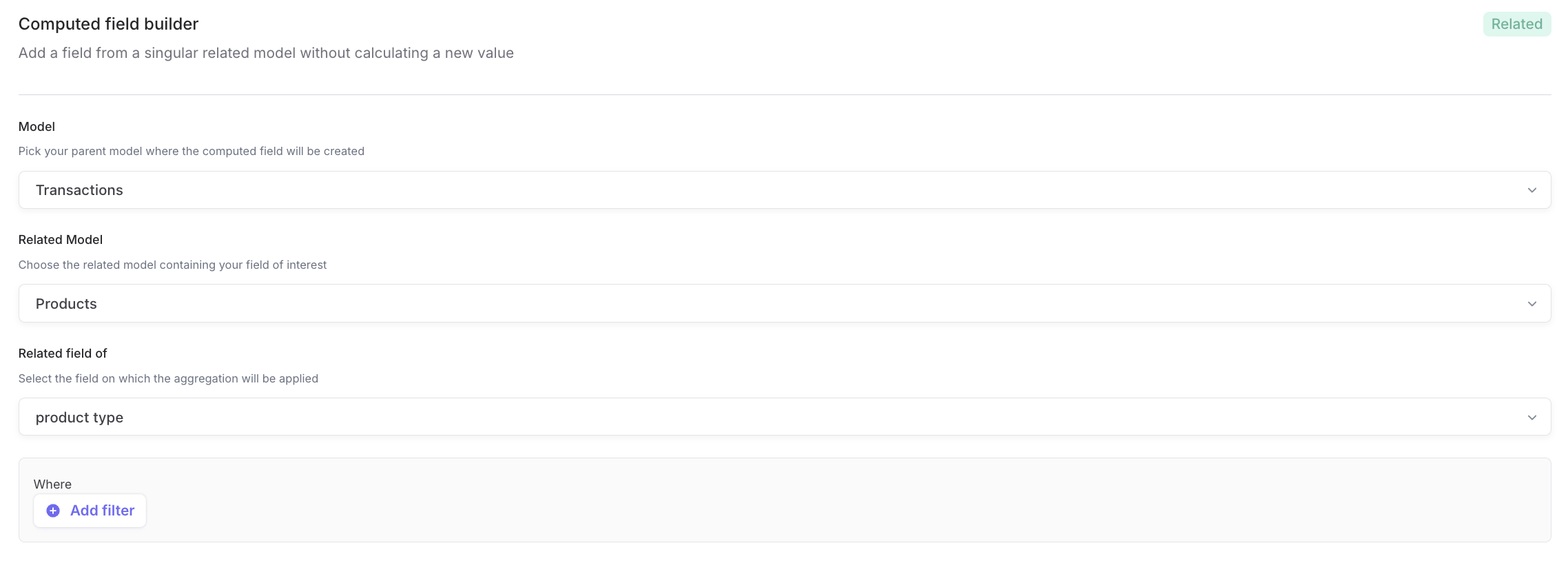
1. Choose the parent model where the Related field will be created.
2. Select the singular related model that contains the field you need.
3. Select the related field.
4. Optionally add filters to restrict the data returned.
Select the parent model, related model, and field to make available for activation mapping.
DinMo does not calculate a new value: it makes the selected field from the related model available for the activation.
## Availability and limitations
Related fields are live fields. They are designed for activation mappings and are not available in the Segment Builder.
Use an Aggregated field instead when you need to calculate a value from multiple related records, such as the total amount of all transactions for a customer.
## Example: send a product type with transactions
You want to activate Transactions to a destination, but the destination also requires the product type.
1. Create a Related field on **Transactions**.
2. Select **Products** as the related model.
3. Select `product_type` as the related field.
4. Map the Related field in the activation.
The product type is available for this activation without duplicating product data in the Transactions model.
---
# Agent Instructions
This documentation is published with GitBook. GitBook is the documentation platform designed so that both humans and AI agents can read, navigate, and reason over technical content effectively. Learn more at gitbook.com.
## Querying This Documentation
If you need additional information that is not directly available in this page, you can query the documentation by asking a question.
Perform an HTTP GET request on the following URL with the `ask` and `goal` query parameters:
```
GET https://docs.dinmo.io/models/computed-fields/related-fields.md?ask=&goal=
```
`ask` is the immediate question: it should be specific, self-contained, and written in natural language.
`goal` is what the user is ultimately trying to achieve, the reason they need the answer. Sharing it helps GitBook give you a better, more relevant answer. A goal is most helpful when it describes the outcome the user wants rather than restating the question. For example, with `ask=how do I create an API token`, a goal like `automate deployments from our CI pipeline` lets GitBook tailor the answer to that use case.
The response will contain a direct answer to the question and relevant excerpts and sources from the documentation.
Use this mechanism when the answer is not explicitly present in the current page, you need clarification or additional context, or you want to retrieve related documentation sections.