> For the complete documentation index, see [llms.txt](https://docs.dinmo.io/llms.txt). Markdown versions of documentation pages are available by appending `.md` to page URLs; this page is available as [Markdown](https://docs.dinmo.io/customer-hub/getting-started/metrics-configuration.md).
# Metrics configuration
## What is a metric?
A metric is an aggregated value for an audience that measures its performance. The main objective of the metrics is to let you **benchmark audiences** and **quantify campaign impact.**
{% hint style="info" %}
Examples of metrics include *Average Order Value*, *Lifetime Value*, *Number of purchases*, etc.
{% endhint %}
## **How to create a new metric?**
### **Step 1:** Go the Metrics section
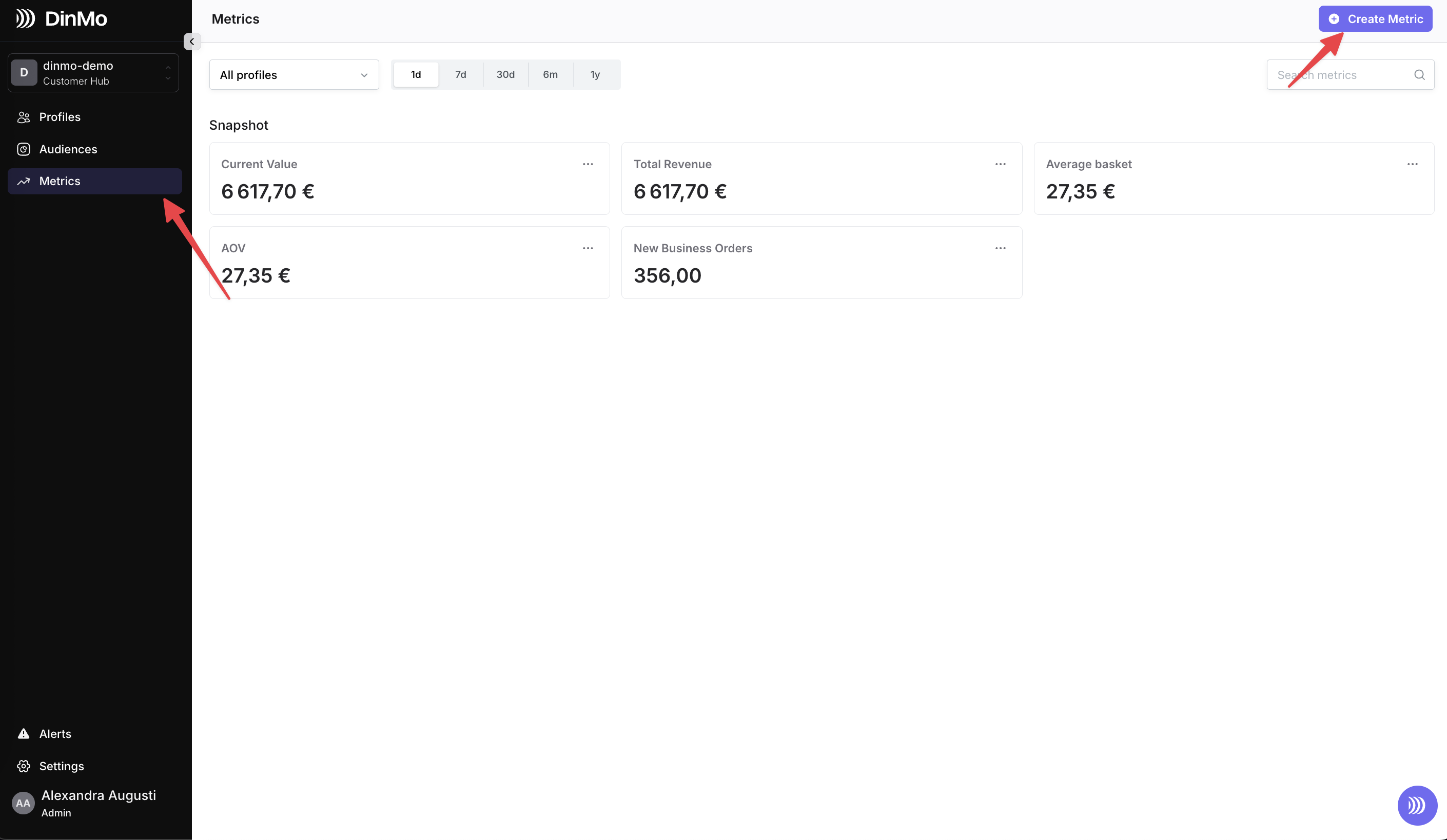
The easiest way to create a metric is to go to the *Metrics* tab and click on *"+ Create Metric"*
### **Step 2:** Enter the data used to calculate the metric
To configure your metric, you need to provide DinMo with several pieces of information:
1. The name of your metric
2. The model you want to aggregate. DinMo will automatically suggest all models related to the user model that is used to define profiles.
3. The field in your Event model that you want to aggregate *(e.g. Price, Order identifier, etc.)*
4. The aggregation rule *(e.g. average, count, sum, etc.)*
5. The format in which you want to view the metric: as a number, monetary value, or percentage.
6. Possible filters to refine the metric results (based on a given product category, time frame, etc.)
7. *(Optional)* The Advanced Settings:
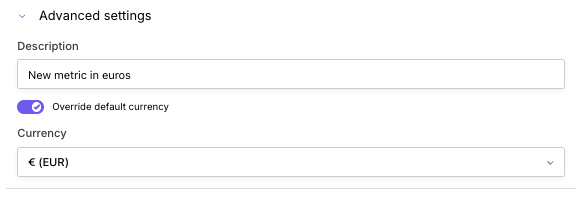
1. You can also add a description to your metric, so that it can be better understood by your teammates.
2. You can decide to override the default currency.
## Monitor your metrics
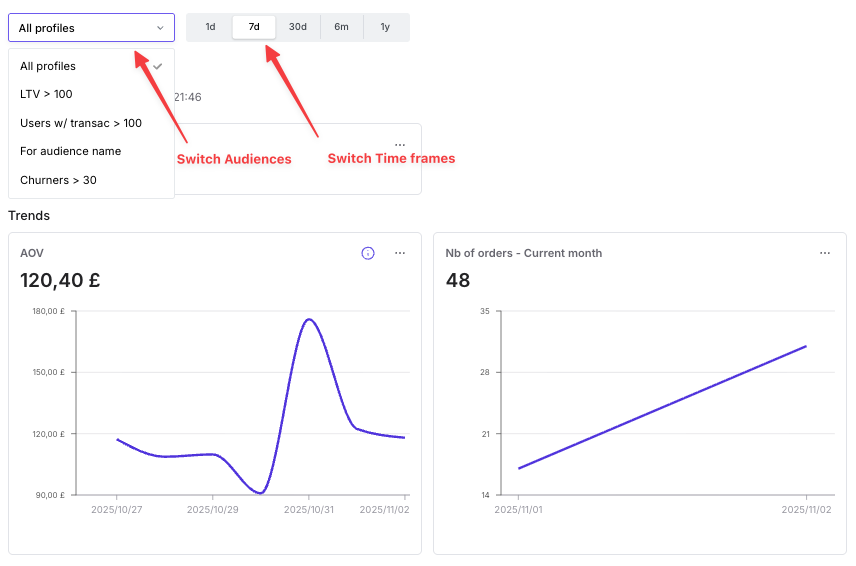
On the metrics tab, you can track the value and evolution of your metrics over time, on different time scales.
You can also choose which audience you want to view a particular metric for, based on the audience settings you have configured.
---
# Agent Instructions
This documentation is published with GitBook. GitBook is the documentation platform designed so that both humans and AI agents can read, navigate, and reason over technical content effectively. Learn more at gitbook.com.
## Querying This Documentation
If you need additional information that is not directly available in this page, you can query the documentation dynamically by asking a question.
Perform an HTTP GET request on the current page URL with the `ask` query parameter, and the optional `goal` query parameter:
```
GET https://docs.dinmo.io/customer-hub/getting-started/metrics-configuration.md?ask=&goal=
```
`ask` is the immediate question: it should be specific, self-contained, and written in natural language.
`goal` is optional and describes the broader end goal you are ultimately trying to accomplish on behalf of the user. GitBook uses it to tailor the answer towards what is most useful for that goal.
The response will contain a direct answer to the question and relevant excerpts and sources from the documentation.
Use this mechanism when the answer is not explicitly present in the current page, you need clarification or additional context, or you want to retrieve related documentation sections.