> For the complete documentation index, see [llms.txt](https://docs.dinmo.io/llms.txt). Markdown versions of documentation pages are available by appending `.md` to page URLs; this page is available as [Markdown](https://docs.dinmo.io/integrations/data-sources.md).
# Data Sources
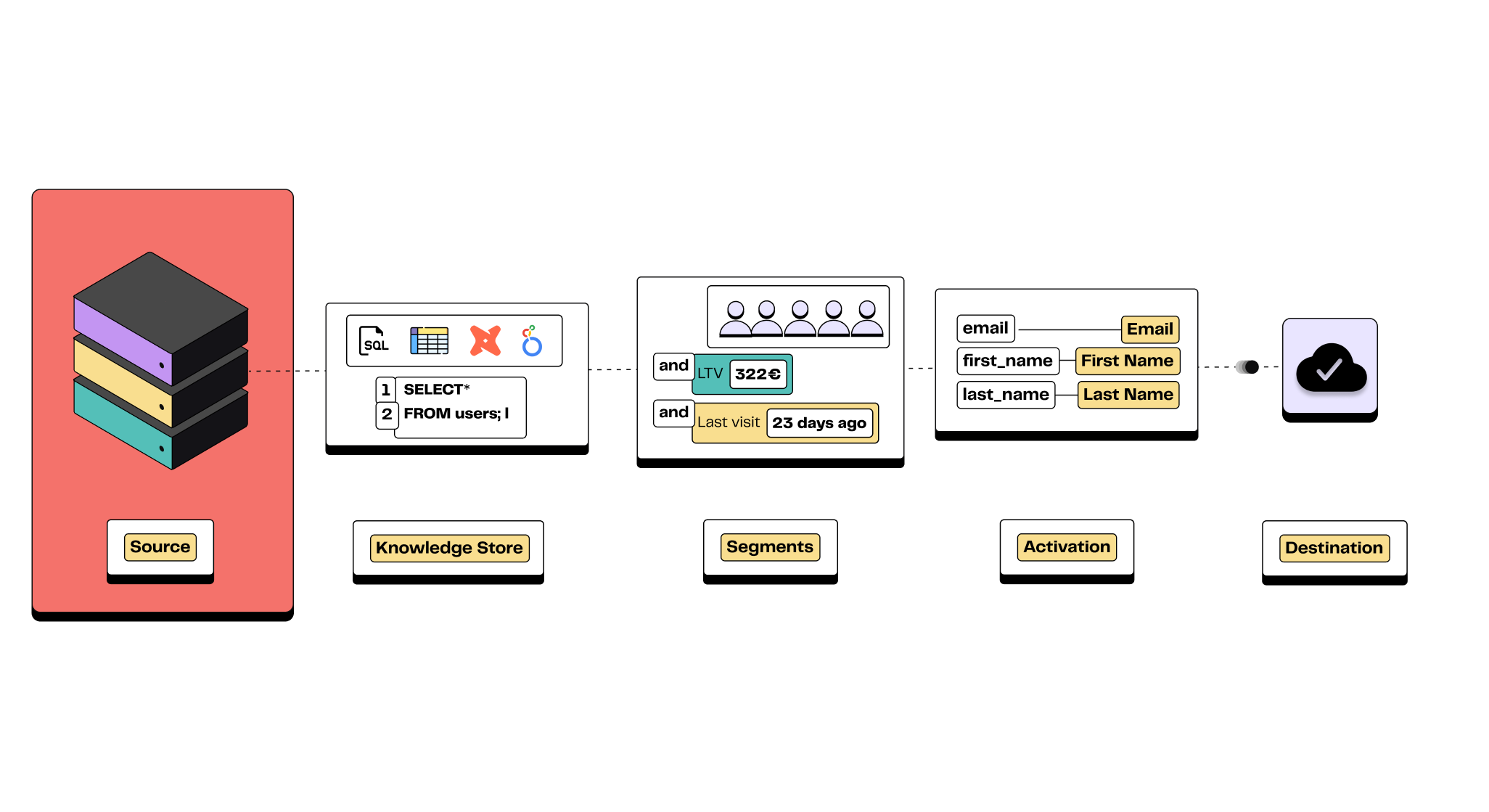
A source refers to the data warehouse where all the data you want to get value from is stored. Snowflake, or Google BigQuery are among the most common data warehouses.
To add a source into your DinMo workspace, you simply need to connect your data warehouse to the platform, ensuring that DinMo has the necessary permissions to read the data and execute jobs.
DinMo uses the source to store some info into specific schemas/datasets:
* `dinmo_segments`: views of the query of the segments and models created within DinMo
* `dinmo_stats`: tables that contain statistics about your segments
* `dinmo_delta_storage`: snapshots of a historical run of segments queries that enable DinMo to calculate the changes that occur on a segment and update, therefore, the activation target.
* `dinmo_predictions`: : For workspaces with the predictions module enabled, this table stores the output generated by the predictions models.
You can add as many sources as you want on your workspace.
{% hint style="info" %}
DinMo will never store data located on your source. Furthermore, every computation will be processed on your DataWarehouse only.
{% endhint %}
## Source configuration
{% hint style="info" %}
If you already have a data warehouse, you can follow the guides below to connect your data source.
Otherwise, consult the DinMo Storage documentation.
{% endhint %}
### Step-by-step guides
You will find below the step-by-step instructions to connect a source to DinMo, specific to each DataWarehouse provider:
* [Google BigQuery](/integrations/data-sources/google-bigquery.md)
* [Snowflake](/integrations/data-sources/snowflake.md)
* [Amazon Redshift](/integrations/data-sources/aws-redshift.md)
* [PostgreSQL](/integrations/data-sources/postgresql.md)
* [Databricks](/integrations/data-sources/databricks.md)
* [Microsoft Fabric](/integrations/data-sources/microsoft-fabric.md)
* [ClickHouse](/integrations/data-sources/clickhouse.md)
Note that only **Admin** users can create and manage sources.
### Advanced settings
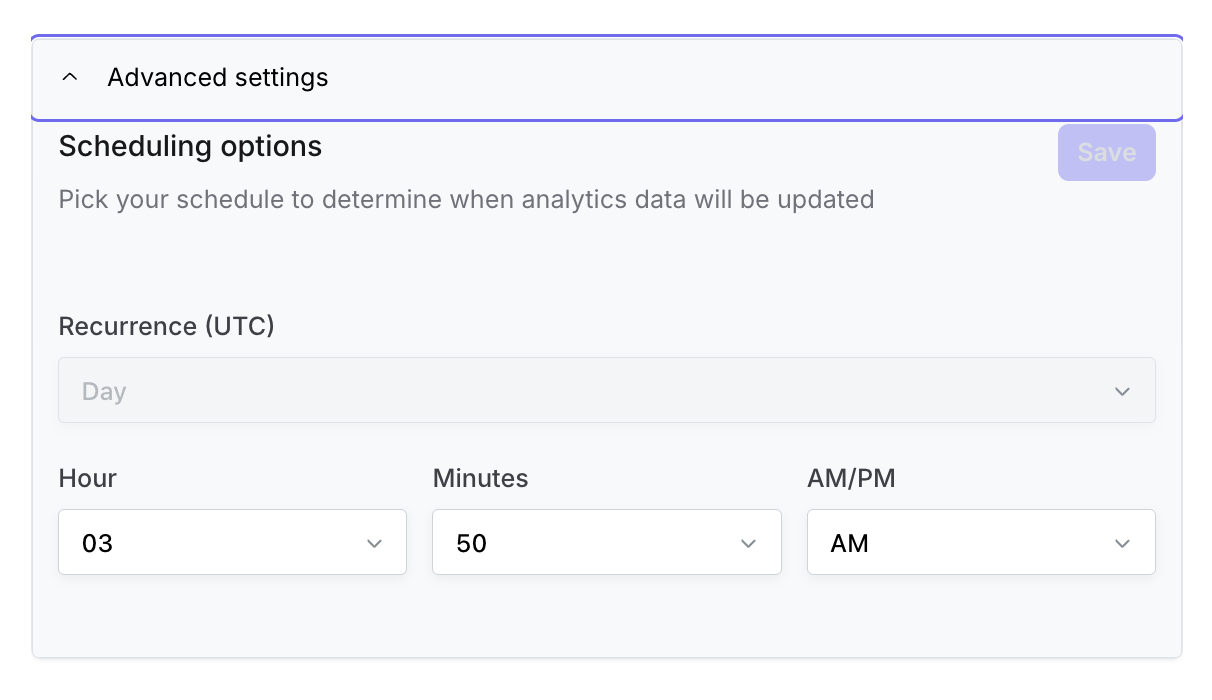
For all the sources listed above, it is possible to set an advanced setting, in particular to choose the time of day when DinMo performs analytical tasks.
All you have to do is click on your source (available in your workspace settings) and go to advanced settings. The schedule can be modified to suit your needs.
{% hint style="info" %}
Only workspace admins can do this operation.
{% endhint %}
***
## Ready to get started?
Book a demo and we will walk through the best way to launch your first DinMo use case.
[Book a demo](https://www.dinmo.com/contact/)
## Need help?
Our team is here to help with setup, modeling, activation, and troubleshooting.
[Contact us](mailto:hello@dinmo.com?subject=Docs%20help)
## Feature requests?
Tell us which connector, workflow, or improvement would make DinMo more useful for your team.
[Request a feature](mailto:hello@dinmo.com?subject=Feature%20request)
[Privacy Policy](https://www.dinmo.com/legals/privacy/) | [Terms of Service](https://www.dinmo.com/terms-of-service/)
---
# Agent Instructions
This documentation is published with GitBook. GitBook is the documentation platform designed so that both humans and AI agents can read, navigate, and reason over technical content effectively. Learn more at gitbook.com.
## Querying This Documentation
If you need additional information that is not directly available in this page, you can query the documentation by asking a question.
Perform an HTTP GET request on the following URL with the `ask` and `goal` query parameters:
```
GET https://docs.dinmo.io/integrations/data-sources.md?ask=&goal=
```
`ask` is the immediate question: it should be specific, self-contained, and written in natural language.
`goal` is what the user is ultimately trying to achieve, the reason they need the answer. Sharing it helps GitBook give you a better, more relevant answer. A goal is most helpful when it describes the outcome the user wants rather than restating the question. For example, with `ask=how do I create an API token`, a goal like `automate deployments from our CI pipeline` lets GitBook tailor the answer to that use case.
The response will contain a direct answer to the question and relevant excerpts and sources from the documentation.
Use this mechanism when the answer is not explicitly present in the current page, you need clarification or additional context, or you want to retrieve related documentation sections.