> For the complete documentation index, see [llms.txt](https://docs.dinmo.io/llms.txt). Markdown versions of documentation pages are available by appending `.md` to page URLs; this page is available as [Markdown](https://docs.dinmo.io/workspace-management/set-up.md).
# Set Up
This guide outlines the steps to set up a workspace on DinMo, including Google Sign-In, best practices for inviting team members and configuring alerts.
## Setting up a workspace
1. **Sign** **up**:
* Navigate to [DinMo Sign-Up](https://app.dinmo.io/sign-up).
* Use your Google Account or Email to sign up.
* During the sign-up process, you will be prompted to name you workspace.
2. **Workspace Validation**:
* Once the workspace is created, the DinMo team will validate it.
* You will receive a confirmation once your workspace is validated and ready to use.
## Getting Started with DinMo
{% hint style="info" %}
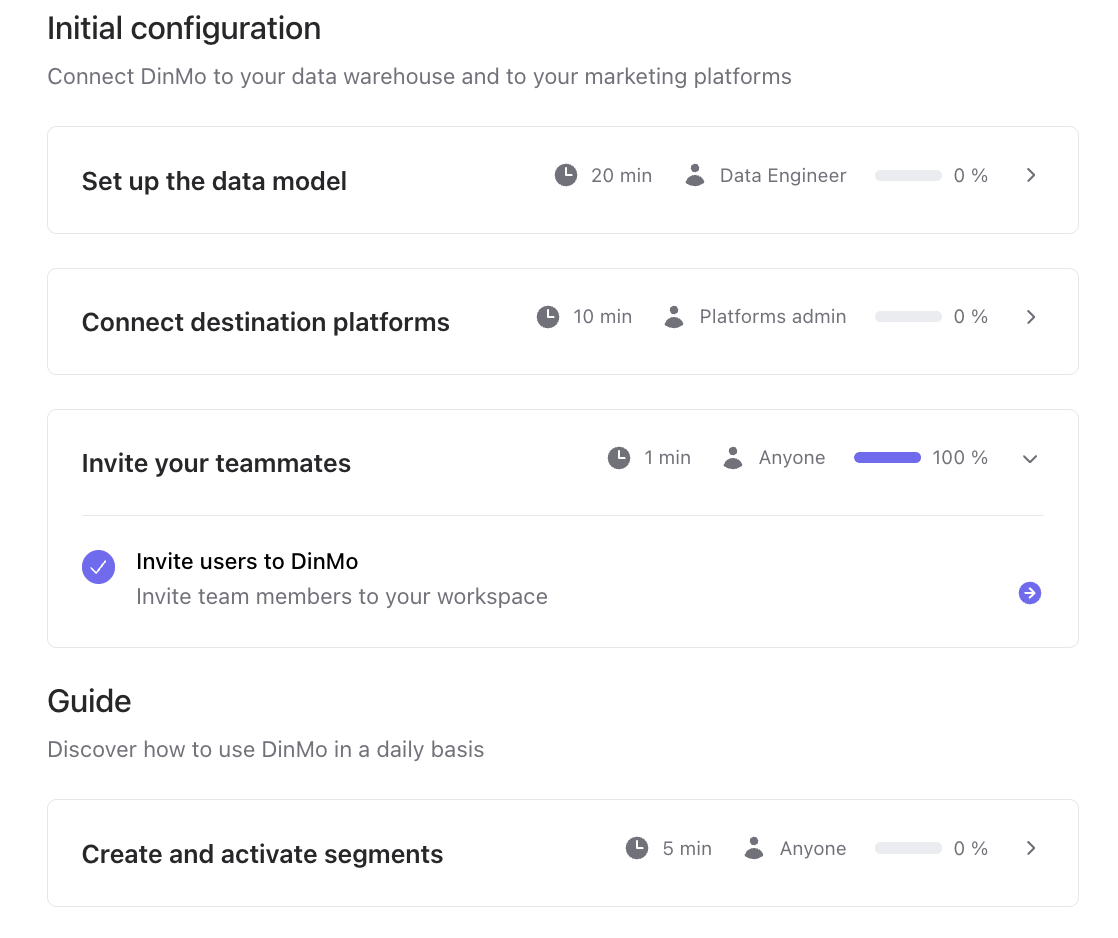
Check our [step-by-step process](#getting-started-with-dinmo) from first log-in to activating your first-party data and seamlessly transferring it to your preferred destination platforms.
{% endhint %}
## Inviting Team Members
* **Best** **Practices**:
* The first person to create the workspace becomes the organization admin and workspace admin.
* After creating the workspace, the admin should invite other team members and assign roles within the organization.
The administrator must invite their team members to join the same workspace
{% hint style="warning" %}
**Avoid** **Multiple** **Workspaces!**
If all team members sign up individually without being invited, separate workspaces will be created. Ensure the admin invites team members to the same workspace.
{% endhint %}
## Setting up Alerts
Workspace administrators can configure failure and validation alerts in **Workspace Settings > General Settings > Workspace alerts**.
Each alert type has its own on/off control, email recipients, and Slack channel. Depending on the features enabled in the workspace, the available alerts can include:
* **Sync failures**
* **Model materialization failures**
* **Customer Hub refresh failures**
* **Journey execution failures**
* **Intelligence failures**
* **Identity resolution failures**
* **Remote segment refresh failures**
* **Schema validation issues**
To use Slack notifications, first connect Slack under **Workspace Settings > General Settings > Slack connection**. Then enable each alert you need, choose its email recipients and/or Slack channel, and save the general settings.
Configure notifications independently for each workspace alert type.
Automatic activation pause notifications are configured separately from the failure and validation alerts above.
## FAQ
1. **Do customers need to configure anything to use Google Sign-On?**
No. Customers simply sign up with their Google account. There is no additional configuration required on their side.
2. **What happens if multiple team members sign up independently?**
Each team member will create their own separate workspace. To avoid this, ensure one person creates the workspace and invites others to join.
***
## Ready to get started?
Book a demo and we will walk through the best way to launch your first DinMo use case.
[Book a demo](https://www.dinmo.com/contact/)
## Need help?
Our team is here to help with setup, modeling, activation, and troubleshooting.
[Contact us](mailto:hello@dinmo.com?subject=Docs%20help)
## Feature requests?
Tell us which connector, workflow, or improvement would make DinMo more useful for your team.
[Request a feature](mailto:hello@dinmo.com?subject=Feature%20request)
[Privacy Policy](https://www.dinmo.com/legals/privacy/) | [Terms of Service](https://www.dinmo.com/terms-of-service/)
---
# Agent Instructions
This documentation is published with GitBook. GitBook is the documentation platform designed so that both humans and AI agents can read, navigate, and reason over technical content effectively. Learn more at gitbook.com.
## Querying This Documentation
If you need additional information that is not directly available in this page, you can query the documentation by asking a question.
Perform an HTTP GET request on the following URL with the `ask` and `goal` query parameters:
```
GET https://docs.dinmo.io/workspace-management/set-up.md?ask=&goal=
```
`ask` is the immediate question: it should be specific, self-contained, and written in natural language.
`goal` is what the user is ultimately trying to achieve, the reason they need the answer. Sharing it helps GitBook give you a better, more relevant answer. A goal is most helpful when it describes the outcome the user wants rather than restating the question. For example, with `ask=how do I create an API token`, a goal like `automate deployments from our CI pipeline` lets GitBook tailor the answer to that use case.
The response will contain a direct answer to the question and relevant excerpts and sources from the documentation.
Use this mechanism when the answer is not explicitly present in the current page, you need clarification or additional context, or you want to retrieve related documentation sections.