> For the complete documentation index, see [llms.txt](https://docs.dinmo.io/llms.txt). Markdown versions of documentation pages are available by appending `.md` to page URLs; this page is available as [Markdown](https://docs.dinmo.io/activations/troubleshooting-syncs/automatic-pause-or-resume-activations.md).
# Automatic pause or resume Activations
DinMo can pause scheduled Activations automatically when system failures make subsequent runs unsafe. This prevents repeated failures and unnecessary source processing until the issue is resolved.
## Configure automatic pauses
Workspace administrators can open **Settings > General Settings > Automatic activation pauses** and configure three policies:
* **Source connection failures**: pause affected Activations after a configurable number of consecutive scheduled connection-check failures, or never pause them automatically for this reason.
* **Destination failures**: pause an Activation after a configurable number of consecutive destination configuration failures, or never pause it automatically for this reason.
* **Schema issues**: pause affected Activations immediately when a supported schema issue is detected, or never pause them automatically for this reason.
Automatic pause notifications are configured separately from general Activation failure notifications. Choose the workspace members who should receive email notifications and, when required, the Slack channel to notify.
## What happens when DinMo pauses an Activation
When a configured threshold is reached, DinMo pauses every affected Activation and records the system condition responsible for the pause.
An Activation can be affected by several system conditions at the same time. It remains paused until every system-owned pause reason has recovered.
## Resume an Activation automatically
DinMo automatically resumes an Activation when the source connection, destination configuration, or schema condition has recovered and no other system-owned pause reason remains.
If automatic pauses are disabled for a condition, DinMo reports the failure without pausing the affected Activation for that reason.
## Review an automatic pause
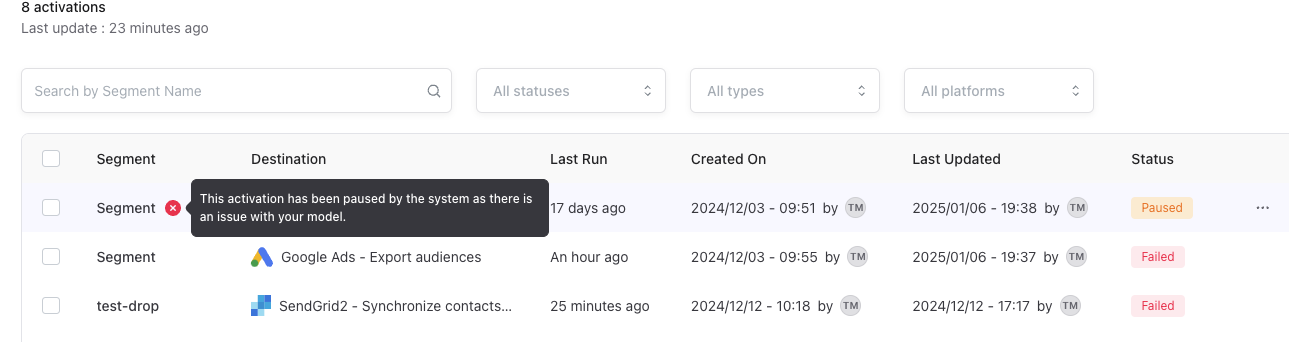
A system-paused Activation displays an issue indicator in the Activation list. Open its tooltip to identify the source, destination, or related entity responsible for the pause.
The corresponding warning also appears in the alert center. Depending on the notification settings, DinMo can additionally notify the configured recipients by email or Slack.
Automatic pause because the model has been altered
---
# Agent Instructions
This documentation is published with GitBook. GitBook is the documentation platform designed so that both humans and AI agents can read, navigate, and reason over technical content effectively. Learn more at gitbook.com.
## Querying This Documentation
If you need additional information that is not directly available in this page, you can query the documentation by asking a question.
Perform an HTTP GET request on the following URL with the `ask` and `goal` query parameters:
```
GET https://docs.dinmo.io/activations/troubleshooting-syncs/automatic-pause-or-resume-activations.md?ask=&goal=
```
`ask` is the immediate question: it should be specific, self-contained, and written in natural language.
`goal` is what the user is ultimately trying to achieve, the reason they need the answer. Sharing it helps GitBook give you a better, more relevant answer. A goal is most helpful when it describes the outcome the user wants rather than restating the question. For example, with `ask=how do I create an API token`, a goal like `automate deployments from our CI pipeline` lets GitBook tailor the answer to that use case.
The response will contain a direct answer to the question and relevant excerpts and sources from the documentation.
Use this mechanism when the answer is not explicitly present in the current page, you need clarification or additional context, or you want to retrieve related documentation sections.