> For the complete documentation index, see [llms.txt](https://docs.dinmo.io/llms.txt). Markdown versions of documentation pages are available by appending `.md` to page URLs; this page is available as [Markdown](https://docs.dinmo.io/integrations/destination-platforms/june-email-marketing/export-contact-lists.md).
# Export Contact Lists
Learn how to create an activation with you June Platform to sync Lists with your DinMo user segments and models
## Overview
DinMo allows you to synchronise your user models or segments directly to the DinMo List created for DinMo activation during the platform setup. Here’s how it works:
* DinMo inserts **new users** who enter your segments or models into your destination list.
* DinMo does **not** delete existing users from your list.
* Users are matched based on their **email address**. If an email already exists, DinMo updates the user without creating duplicates.
* DinMo uses **Tags** to identify segments and models within your list. When syncing, DinMo assigns a specific tag to each user, which directly corresponds to the **name of the user segment or model** defined in the DinMo platform. This allows you to easily identify and leverage these users for personalised marketing.
* If a user matches an existing email but is part of a newly synced segment, DinMo adds the relevant new tag without duplicating the user.
{% hint style="warning" %}
**Note:** DinMo does not delete or remove existing users from your contact list, even if they exit a segment definition. DinMo only updates tags to reflect current segment memberships.
{% endhint %}
## Setting Up a June Destination for Segment Sync
To synchronize your segments or models with June, you'll first need to create a June destination in DinMo using the **Export Contact Lists** type:
{% hint style="info" %}
Learn how to create such a destination in our[ step-by-step tutorial](/guides/get-started-with-dinmo/initial-configuration-of-dinmo/create-a-destination.md)
{% endhint %}
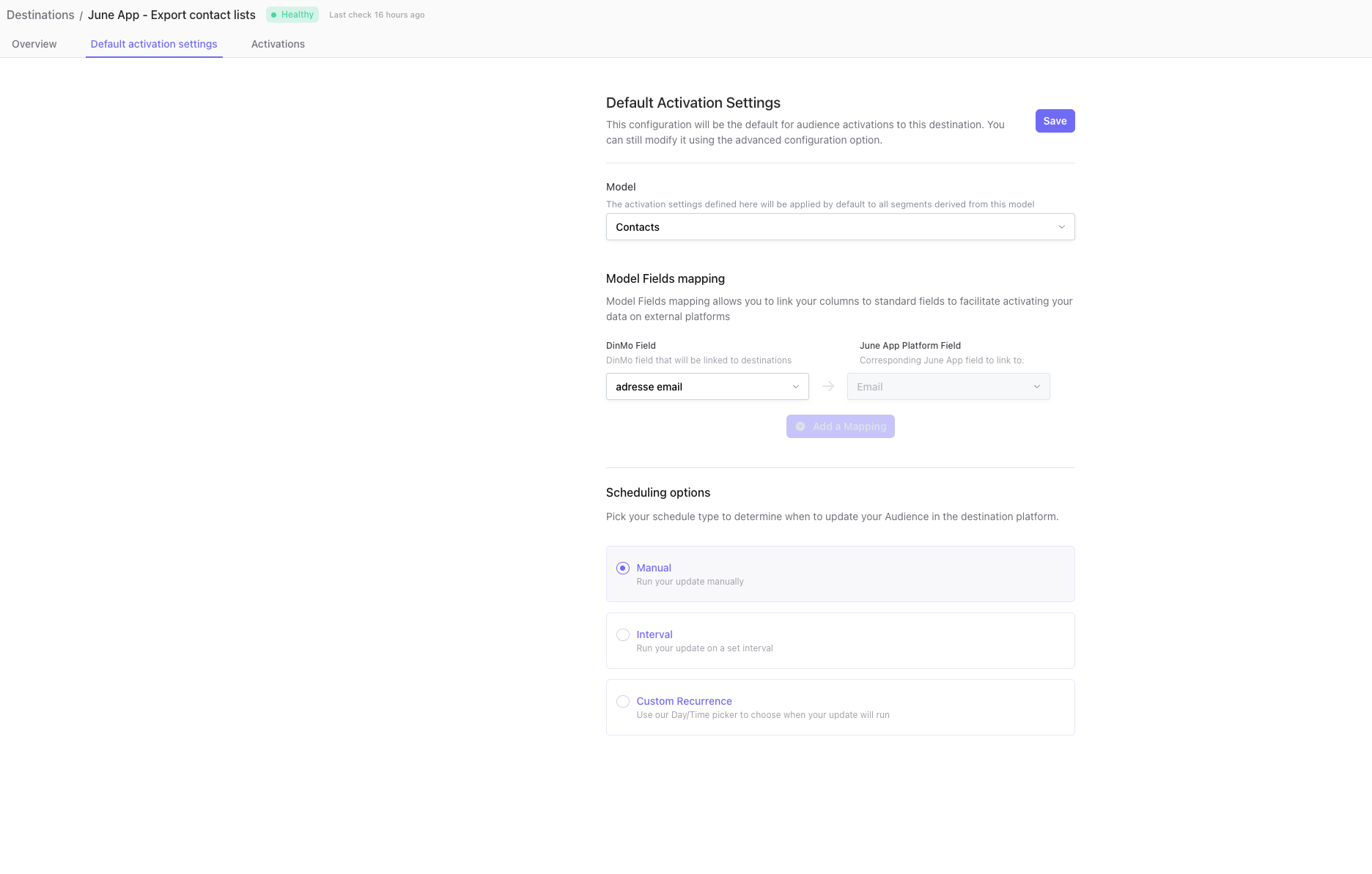
* Configure the **default activation settings** for quick and easy future segment activations:
* Navigate to your destination in DinMo.
* Select the **Default Activation** tab.
* Choose your main User Model corresponding to the users in your June instance.
* Select the email field used in your June instance to ensure correct user matching.
## Creating and Using Segments in June
After your destination is ready, follow these steps to create and manage segments based on DinMo data:
* Log in to your **June** app.
* Navigate to the **DinMo List** you created earlier.
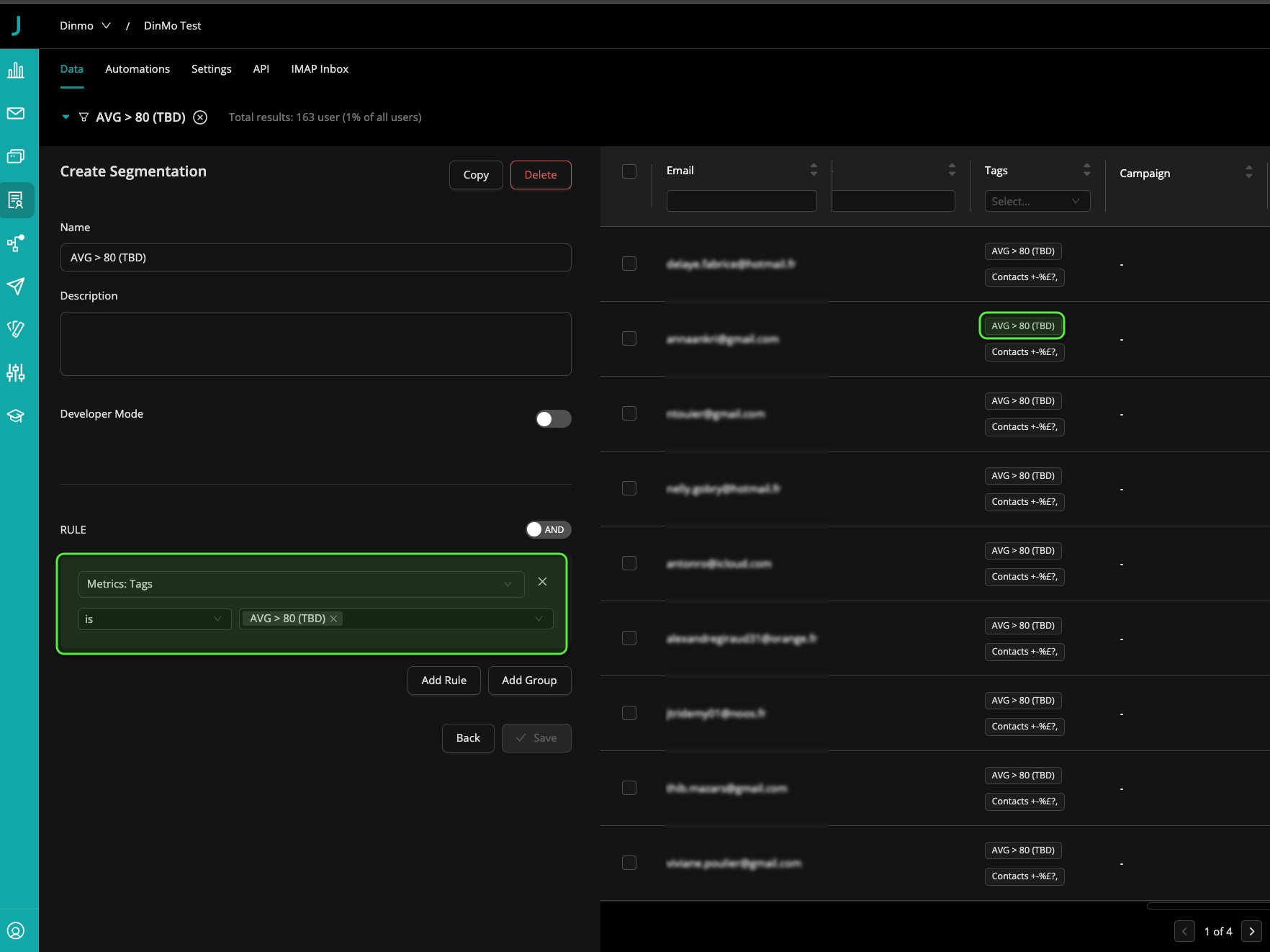
* Click on **Select Segmentation**, then choose **Add Segmentation**.
* Provide a clear segment name (ideally matching your DinMo segment name).
* Set segmentation rules using the **is** condition based on your available **Metrics: Tags**.
* Enter the tag name exactly as assigned by DinMo.
Your new segments can now be effectively used for personalised email campaigns and targeted messaging.
---
# Agent Instructions
This documentation is published with GitBook. GitBook is the documentation platform designed so that both humans and AI agents can read, navigate, and reason over technical content effectively. Learn more at gitbook.com.
## Querying This Documentation
If you need additional information that is not directly available in this page, you can query the documentation by asking a question.
Perform an HTTP GET request on the following URL with the `ask` and `goal` query parameters:
```
GET https://docs.dinmo.io/integrations/destination-platforms/june-email-marketing/export-contact-lists.md?ask=&goal=
```
`ask` is the immediate question: it should be specific, self-contained, and written in natural language.
`goal` is what the user is ultimately trying to achieve, the reason they need the answer. Sharing it helps GitBook give you a better, more relevant answer. A goal is most helpful when it describes the outcome the user wants rather than restating the question. For example, with `ask=how do I create an API token`, a goal like `automate deployments from our CI pipeline` lets GitBook tailor the answer to that use case.
The response will contain a direct answer to the question and relevant excerpts and sources from the documentation.
Use this mechanism when the answer is not explicitly present in the current page, you need clarification or additional context, or you want to retrieve related documentation sections.