> For the complete documentation index, see [llms.txt](https://docs.dinmo.io/llms.txt). Markdown versions of documentation pages are available by appending `.md` to page URLs; this page is available as [Markdown](https://docs.dinmo.io/integrations/destination-platforms/klaviyo/synchronise-contacts.md).
# Synchronise contacts
## Overview
In this destination service, DinMo will create and update your profiles attributes. Unknown contacts will be created.
To do so, you will need to go through these three steps:
* Creating a Klaviyo destination. Refer to the [corresponding section](#destination-set-up) for more info.
* Creating a user segment composed of all the users that will need to be created or updated in your Klaviyo account. Refer to this [step-by-step tutorial](/guides/get-started-with-dinmo/create-and-activate-segments-on-dinmo/create-your-first-segment.md) to learn how to build segments without SQL in DinMo.
* Activating the segment to the Klaviyo destination to start sending data. Refer to the corresponding section for more info.
Each time the activation will be running:
* Any unknown profile will be created in Klaviyo
* Any profile attribute changes will be synchronized with Klaviyo, either by updating existing attributes or creating new ones.
## Destination set up
To start exporting lists, you are first required to create a Klaviyo destination with the corresponding destination service: "Klaviyo - Synchronize contacts"
{% hint style="info" %}
Learn how to create such a destination in our[ step-by-step tutorial](/guides/get-started-with-dinmo/initial-configuration-of-dinmo/create-a-destination.md)
{% endhint %}
## Activation configuration
Once the destination has been setup, and your DinMo segment created, you can create an activation to start sending data to Klaviyo right away. The segment will be exported as a contact list in Klaviyo.
### Fields mapping
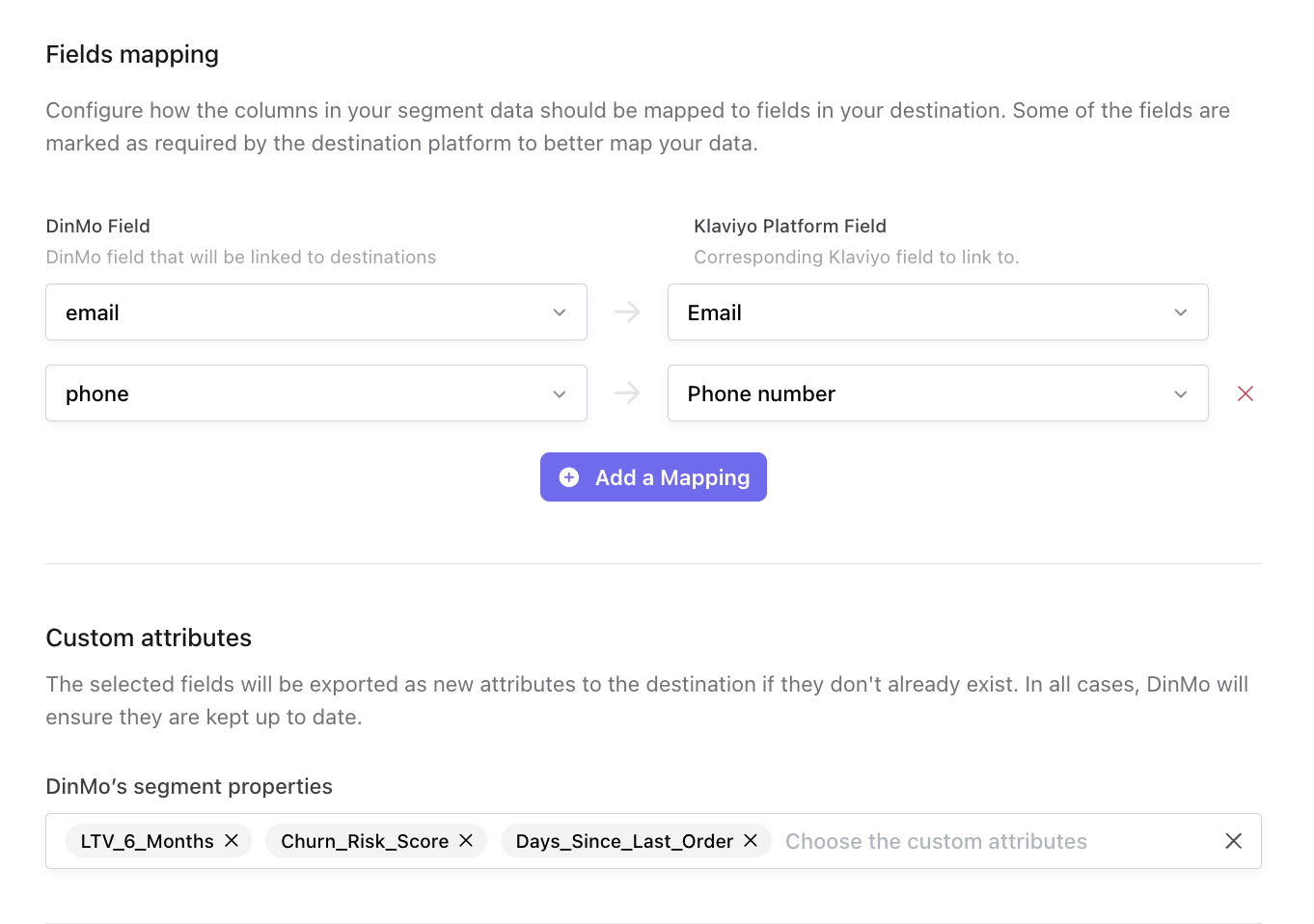
In the Fields mapping section, you are asked to specify which field corresponds to the matching key of the users of the segment.
{% hint style="info" %}
The user can choose between email, phone number, or Klaviyo ID as the mandatory matching key for the profile sync.
{% endhint %}
The user can select additional profile attributes from the existing options in Klaviyo.
The user also has the option to create new custom attributes (in the *"Custom attributes"* section, which will be added during the first synchronization.
Standard and custom attributes will be updated in your Klaviyo account
### Scheduling
In this section, specify how often the list should be updated in Klaviyo. Every time the list is updated:
* Any new user having entered your DinMo segment since the last update will be updated (and created, if he was previously unknown)
* Any user having left your DinMo segment since the last update will stop being updated
---
# Agent Instructions
This documentation is published with GitBook. GitBook is the documentation platform designed so that both humans and AI agents can read, navigate, and reason over technical content effectively. Learn more at gitbook.com.
## Querying This Documentation
If you need additional information that is not directly available in this page, you can query the documentation by asking a question.
Perform an HTTP GET request on the following URL with the `ask` and `goal` query parameters:
```
GET https://docs.dinmo.io/integrations/destination-platforms/klaviyo/synchronise-contacts.md?ask=&goal=
```
`ask` is the immediate question: it should be specific, self-contained, and written in natural language.
`goal` is what the user is ultimately trying to achieve, the reason they need the answer. Sharing it helps GitBook give you a better, more relevant answer. A goal is most helpful when it describes the outcome the user wants rather than restating the question. For example, with `ask=how do I create an API token`, a goal like `automate deployments from our CI pipeline` lets GitBook tailor the answer to that use case.
The response will contain a direct answer to the question and relevant excerpts and sources from the documentation.
Use this mechanism when the answer is not explicitly present in the current page, you need clarification or additional context, or you want to retrieve related documentation sections.