> For the complete documentation index, see [llms.txt](https://docs.dinmo.io/llms.txt). Markdown versions of documentation pages are available by appending `.md` to page URLs; this page is available as [Markdown](https://docs.dinmo.io/integrations/destination-platforms/braze.md).
# Braze
Sending data to Braze: Step-by-Step Guide
## Supported Destination Services
DinMo supports the following destination services:
* [Synchronize users attributes](/integrations/destination-platforms/braze/synchronize-users-attributes.md)
* [Send track events](/integrations/destination-platforms/braze/send-track-events.md)
* [Synchronize subscription statuses](/integrations/destination-platforms/braze/synchronize-subscription-statuses.md)
* [Export user lists](/integrations/destination-platforms/braze/export-user-lists.md)
Please refer to the dedicated documentation page for more information.
## Authentication to Braze
DinMo can push your segments and data models directly into Braze via its REST API. This guide shows you how to create the necessary API key in Braze and configure the connection in DinMo.
***
### 1. Prerequisites
* **DinMo access** with permission to create Destinations.
* **Braze account** with Developer-level access (to create API keys).
* **Braze REST API Endpoint** and **Dashboard URL** for your instance:
* US instance example:
* REST API: `https://rest.iad-01.braze.com`
* Dashboard: `https://dashboard.iad-01.braze.com`
* EU instance example:
* REST API: `https://rest.eu-01.braze.com`
* Dashboard: `https://dashboard.eu-01.braze.com`
### 2. Create an API Key in Braze
1. Log into your Braze dashboard.
2. Navigate to **Developer Console** → **API Settings**.
3. Click **Create API Key**.
4. In the modal:
* **Name**: e.g. `DinMo Integration`
* **Key Type**: REST API
* **Permissions**: grant the following scopes as needed:
| **Permission Scope** | **Description** |
| ------------------------- | ----------------------------------------------------------------------- |
| `users.track` | Create or update user profiles and track custom events |
| `users.export.ids` | Export user IDs for bulk operations |
| `users.delete` | Delete user profiles *(optional if you handle deletions via Hightouch)* |
| `users.alias.update` | Update existing user aliases |
| `subscription.status.set` | Set or update subscription status on user profiles |
5. Click **Save**, then **Copy** the generated **API Key**.
### 3. Configure the Braze Destination in DinMo
1. In DinMo, go to **Destinations** in the side nav.
2. Click **Add a new destination** → **Connect a new platform** → **Braze**.
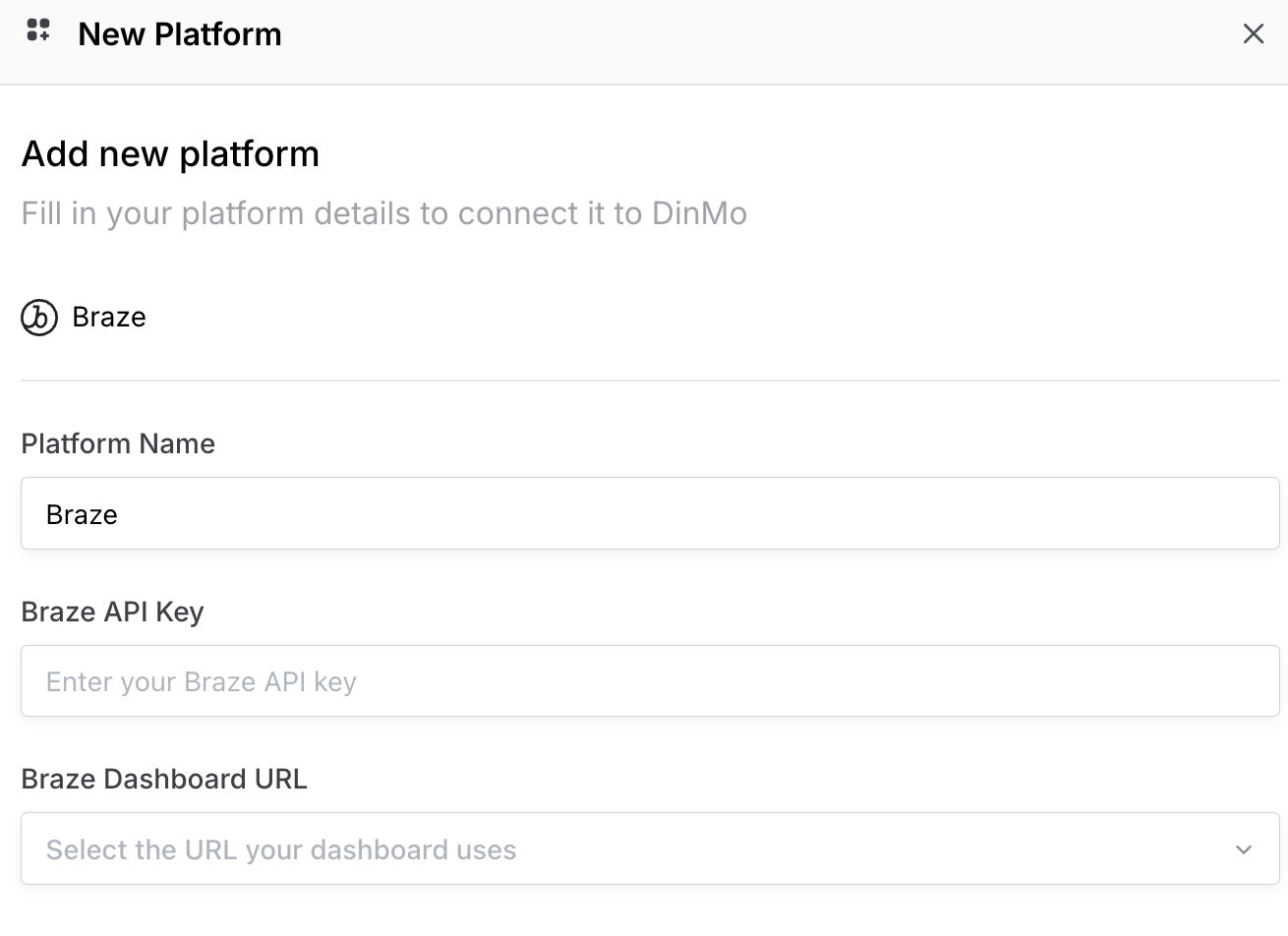
3. Fill out the form:
* **Platform Name**: e.g. `Braze – Your Company`
* **REST API URL**: your instance’s endpoint (e.g. `https://rest.eu-01.braze.com`)
* **Dashboard URL**: your instance’s dashboard (e.g. `https://dashboard.eu-01.braze.com`)
* **API Key**: paste the key you copied from Braze
4. Click **Connect** to validate your credentials.
{% hint style="info" %}
You must as well specify the dashboard URL. Refer to this [documentation](https://www.braze.com/docs/user_guide/administrative/access_braze/sdk_endpoints) for more information.
{% endhint %}
***
### 4. Verify & Test
* After saving, DinMo will perform a test call (e.g. `users.track`) to ensure your key and endpoint work.
* On failure, double-check:
* REST API URL (no trailing slash)
* API Key correctness and scopes
* That your Braze IP allow-list (if enabled) includes DinMo’s IPs
---
# Agent Instructions
This documentation is published with GitBook. GitBook is the documentation platform designed so that both humans and AI agents can read, navigate, and reason over technical content effectively. Learn more at gitbook.com.
## Querying This Documentation
If you need additional information that is not directly available in this page, you can query the documentation by asking a question.
Perform an HTTP GET request on the following URL with the `ask` and `goal` query parameters:
```
GET https://docs.dinmo.io/integrations/destination-platforms/braze.md?ask=&goal=
```
`ask` is the immediate question: it should be specific, self-contained, and written in natural language.
`goal` is what the user is ultimately trying to achieve, the reason they need the answer. Sharing it helps GitBook give you a better, more relevant answer. A goal is most helpful when it describes the outcome the user wants rather than restating the question. For example, with `ask=how do I create an API token`, a goal like `automate deployments from our CI pipeline` lets GitBook tailor the answer to that use case.
The response will contain a direct answer to the question and relevant excerpts and sources from the documentation.
Use this mechanism when the answer is not explicitly present in the current page, you need clarification or additional context, or you want to retrieve related documentation sections.